What is a college union? The most obvious answer might be that it is a
physical building where students, staff, and faculty gather outside of the
classroom. But the functionality of college unions extends far beyond the
walls they occupy.
In their chapter “Revisiting the Role of the College Union”, Rouzer, De
Sawal, and Yakaboski remind us that “the historical roots of college unions
are grounded in student involvement and recreation” and that, at its core,
“a college union is the campus leader in building community” (2014, p. 11).
Neither definition mentions a building at all. Instead, they emphasize
purpose: cultivating community between students, between students and
faculty, between staff and faculty, and across all campus stakeholders.
This distinction matters. The ideal is that the resources, services, and
events that take place in college unions are not defined by their location,
but by their intention. As Rouzer and colleagues note, “college union ideals
surrounding the creation of community do not have to be tied to one specific
space” (2014, p. 12). Community can be built anywhere on campus, so long as
there is purpose behind it.
That idea is especially resonant now, during this transitional moment for
Long Beach State University (LBSU). As the University Student Union (USU)
undergoes its largest transformation since its opening in 1972, our
community has the opportunity to focus less on bricks and mortar and more on
cultivating new ways to connect, support, and grow together.
Students as Community Builders
The students of Long Beach State have long understood the importance of
building community. In the 1960s, students recognized that the Soroptimist
House—built and donated to LBSU in 1957 to serve as the first “union” space
on campus—could no longer meet the needs of a rapidly expanding student
body. The class of 1965 voted overwhelmingly, by 74%, to assess a fee to
construct and maintain a new student body center. Groundbreaking took place
in 1969, and three years later, the USU opened its doors.
The philosophy guiding this new building was clear. Students and
administrators envisioned a space that would help the “masses of students”
develop “a broader individual realization of personal, social, intellectual,
cultural, and civic potential … provided outside of the classroom.” In other
words, they knew that college was about more than coursework. It was about
relationships, growth, and shared experiences.
A Building That Reflects Student Life
Over its 53-year history, the USU has mirrored the changing realities of
student life. In 1972, a music listening lounge was a centerpiece of the
building. By the 1980s and 1990s, the Walkman made shared listening less
relevant. In the 2000s, iPods and streaming platforms like Spotify finished
the job. The music lounge, once a place for shared listening, eventually
gave way to Sbarro—transforming from a space of sonic escapes to one serving
slices by the plate.
When food insecurity became an urgent issue for students, USU space was
repurposed to create the Beach Pantry, later expanded as the Laurén Chalmers
’83 Beach Pantry, offering free pantry staples to support students’ basic
needs and by extension, their academic success. As demographics shifted,
lactation rooms and gender-neutral restrooms were added, creating spaces of
inclusion for nursing mothers and for all students.
Each adaptation tells the same story: the USU has never been a stagnant
fixture on campus. It has always been responsive to the needs, challenges,
and aspirations of students.
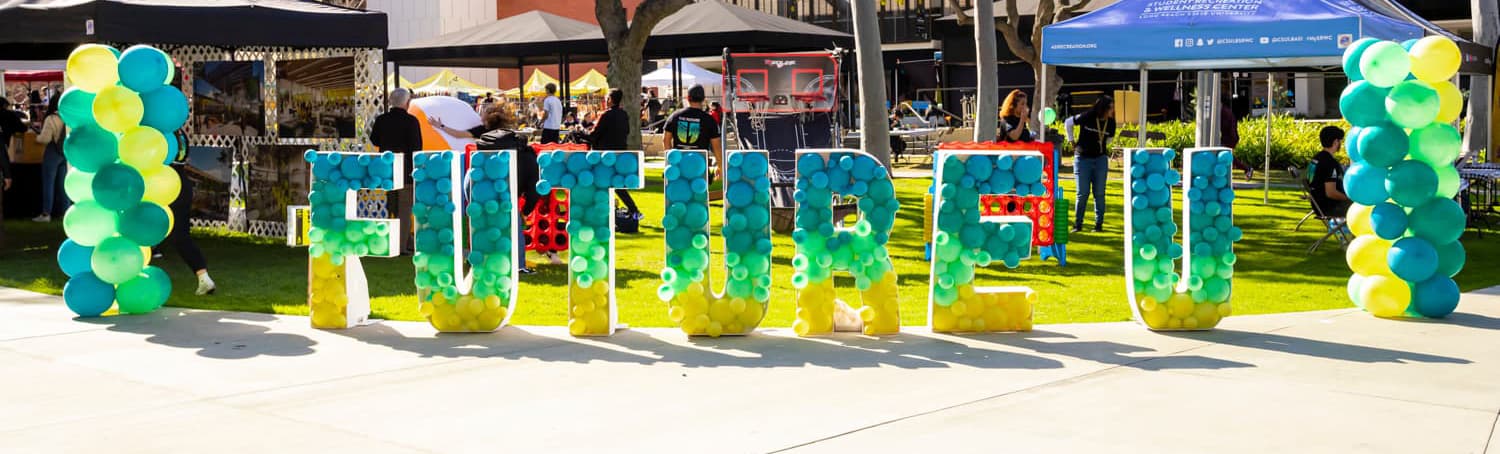
Looking Ahead: Future U
The Future U project continues this tradition of adaptation. Just as the
Soroptimist House in 1957, the USU in 1972, and the Student Recreation &
Wellness Center in 2010 all represented forward-looking investments, the
Future U is the next step.
While the building itself evolves, the responsibility of those who steward
it remains the same: to sustain and expand community. Rouzer and colleagues
describe college union professionals as “community builders in the 21st
century” (2014, p. 13). That charge has never been more relevant.
We mark this milestone by honoring the history and legacy of the students
who came before us—students who fought for change so that future generations
would have the spaces and services they needed to thrive. The Future U
Groundbreaking, held on the very same day the USU first opened its doors in
1972, is not simply the start of a construction project. It is a celebration
of continuity and renewal. It is a reminder that students have always been
the driving force behind shaping spaces that reflect their peers’ needs. And
it is an invitation to imagine new, adaptive ways of building community in
the years ahead.
From the Soroptimist House to the USU, from the SRWC to Future U, each
generation of Long Beach State students has invested in the next. Today, it
is our turn to carry that legacy forward.